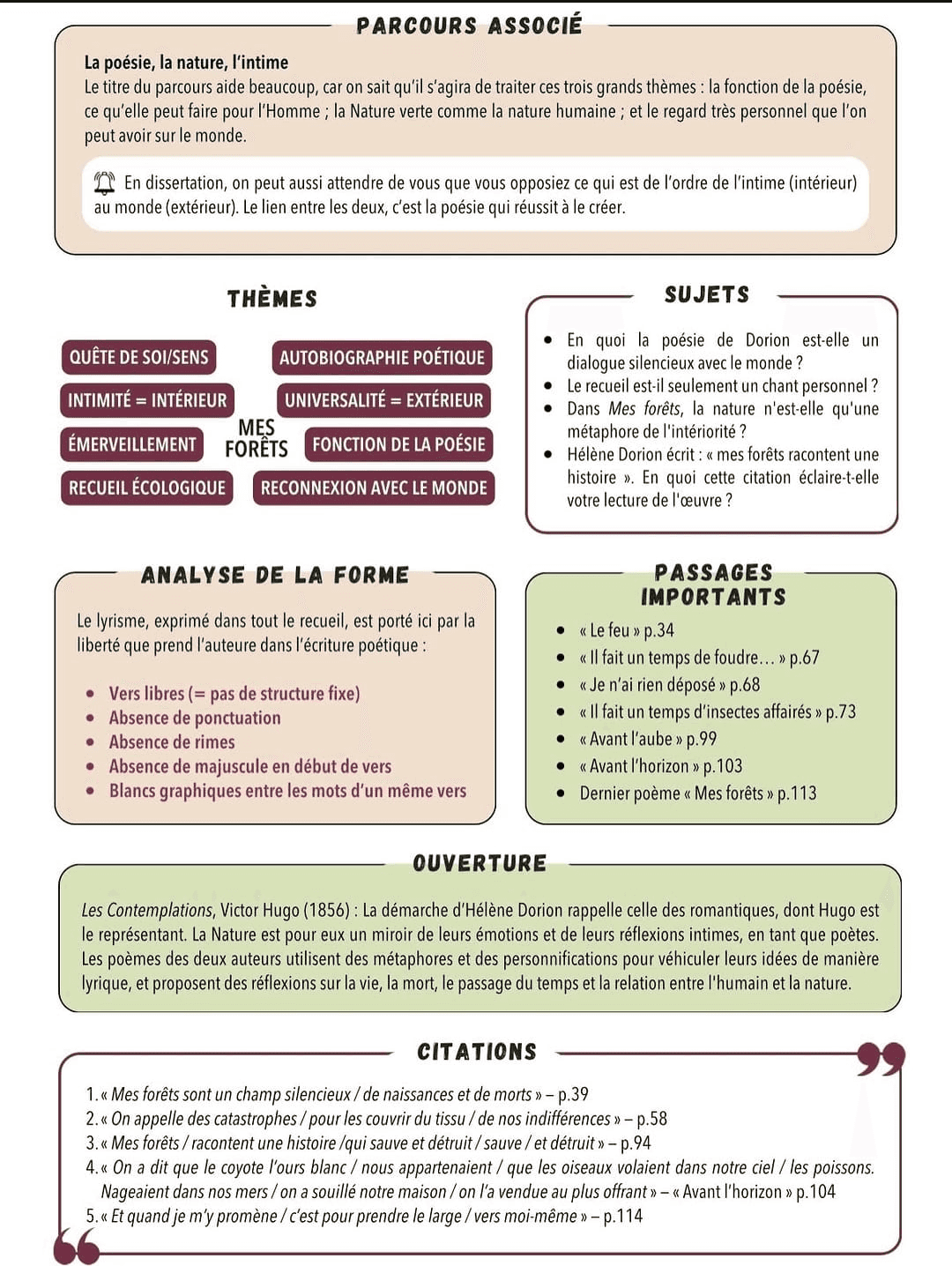
01 · REALISTICFrench · Poetry
As if made by hand
Titles, quotes and book pages. A clean sheet that looks neatly written out.
Study from your course
Create your study sheets with AI, test yourself with corrected quizzes, ask questions about your course and review concepts with flashcards. PDF or photo depending on your plan.
Free plan available · No credit cardPhotos depending on plan
More than 1,300
students study with Fichea
From 8/20 à 17/20
What changes
The longest part is making the sheet and finding exercises. Fichea does it with your course. You study.
3 h per course
9× less time
20 min per course
Personalization
Choose your own study sheet style.
Titles, quotes and book pages. A clean sheet that looks neatly written out.
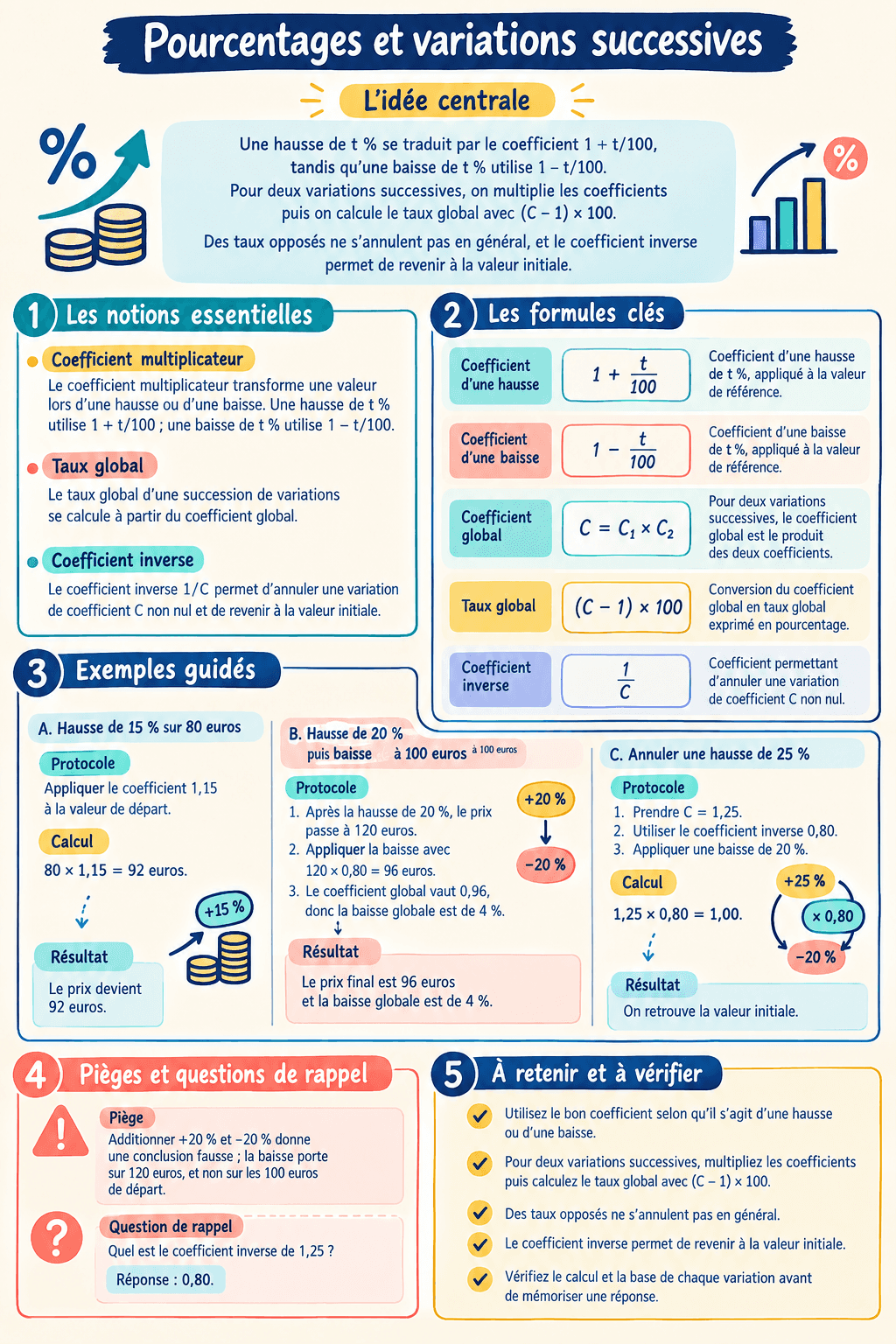
Formulas, method, guided examples. Few images, a page you can reread quickly.
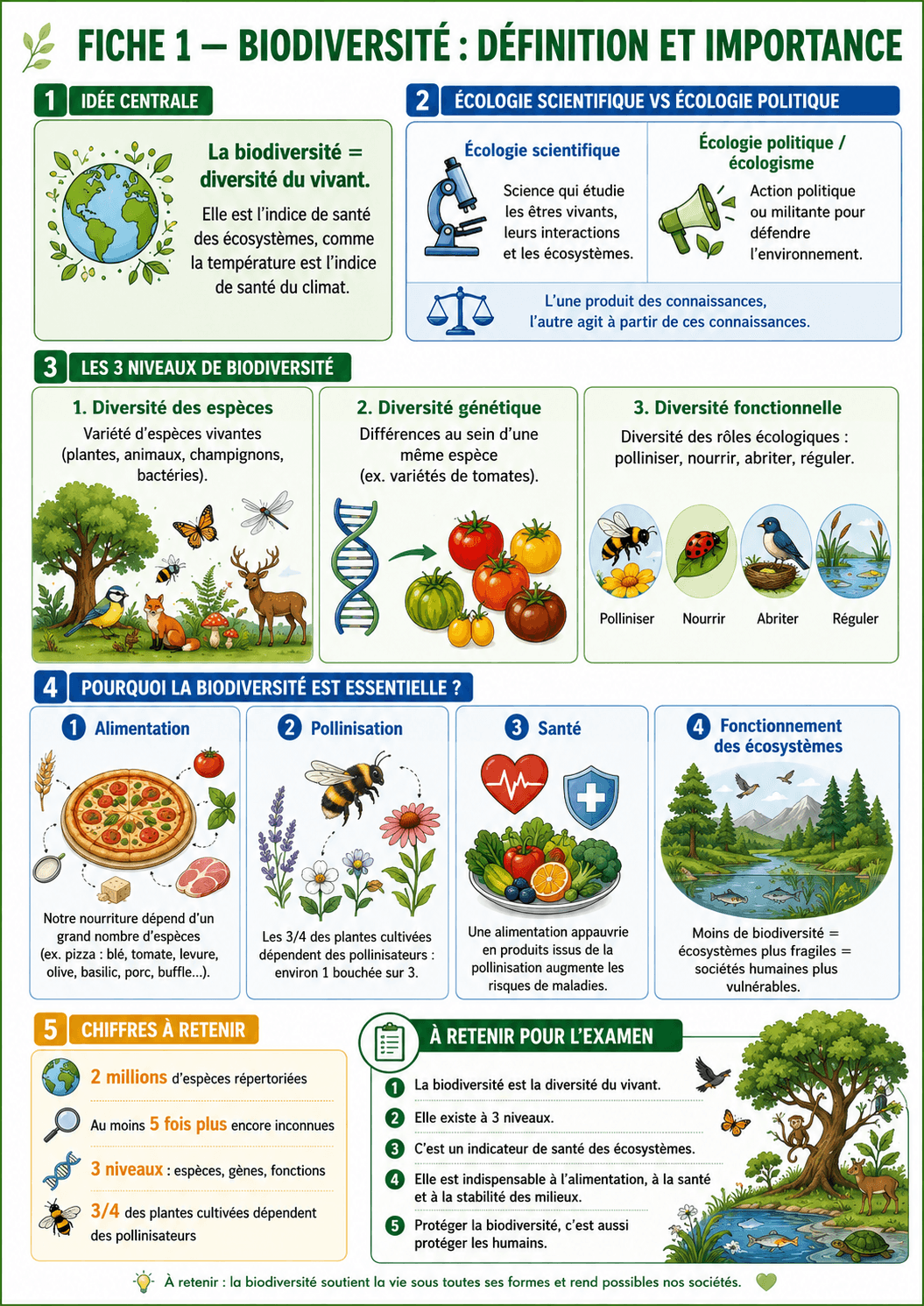
Illustrations, emojis and key figures. To remember at a glance.
Swipe to see the 3 styles
Why Fichea
Understand the concepts so you can explain them in your own words.
It all starts from what your teacher gave you: your course as a PDF or photo.
Web search: off
Fichea reads your course and builds the sheet, quizzes and flashcards from it, with your teacher’s words and examples. Web search stays off. If you turn it on for an extra, it’s marked “outside the course”.
€80 + 15% = ?
Source · p. 2… an increase of t% translates to the coefficient 1 + t/100 …
The questions are based on passages from your course. Doubt about a correction? You reread the cited excerpt and check for yourself, instead of taking the AI’s word for it.
What color is the white horse in the book?
A. BlackB. WhiteYOUR ANSWERC. GrayToo easy!No “white horse” questions. You choose the level, then practice on course questions, practical cases and calculations. The wrong answers look like real mistakes, and every correction explains the reasoning.
1 · YOU CHOOSE YOUR STYLE
2 · YOU ASK YOUR QUESTION
Choose your sheet’s style: very clean, pitfalls to remember, timeline… Stuck on a passage? Ask your question about your course, there’s no such thing as a dumb question. Your next quizzes take it into account.
Quizzes
Course questions, practical cases and calculations to prepare for your exam, with a difficulty suited to your level.
The course you provide is the basis for the questions.
The wrong answers look like real mistakes.
The right answer, how to get there, and where you went wrong.
A price drops 20%, then rises 20%. Compared with the starting price, the final price is…
Classic trap: percentages don’t cancel out.
0.8 × 1.2 = 0.96. The final price is 96% of the start, so −4%.
Source · Successive changes, p. 3A demo to try
Drag the sample course into the folder.
Follow the arrows and try the quiz.
In the subject of your choice
Drop the course hereor click the document
Grab the document and drag it into the folder.
To increase a value by t%, multiply it by 1 + t / 100. For a 15% increase, the coefficient is therefore 1.15. For example, a price of €80 becomes 80 × 1.15 = €92.
The concepts from the course, organized
The sheet appears once the course is added.
With a question from the sheet
Create the sheet to try a question.
From the course to the next review session
You can start by organizing your course or testing yourself right away. Each tool meets a need in your session.
Summarize a course PDF →Organize the definitions, formulas and examples from your PDF or photo. Check the summary against your course.
Create an AI study sheet →Create a quiz from your courses or sheets. Answer, read the correction and spot what still gives you trouble.
Generate a quiz →Ask for an explanation or an example from your course PDF. Find the cited passages to check the answer.
Chat with a course PDF →Find the answer before flipping the card. Come back to hard definitions, dates and formulas in your next sessions.
Create flashcards with AI →Studying tailored to every path
Preparing for an exam, going back to school or helping a student? Choose a starting point and materials that fit.
Choose my pathQuestions on classic mistakes, answers backed by your course and visual sheets to find the key ideas again.
Tired of quizzes that are too easy?
Fichea finds the key concepts, methods and classic mistakes in your course. Your quizzes have real traps, and every correction explains why, backed by your course.
Which symbol stands for a percentage?
Got it right without studying.
A €100 item goes up 20%, then drops 20%. What is its final price?
€96. The drop applies to €120, not €100: 120 × 0.80 = €96. Opposite rates don’t cancel out.
Example taken from a course on percentages.
Worried the AI will go off-syllabus?
Luna, your study assistant, answers from your course and shows you the passages it used. If your course doesn’t cover it, she can let you know. Check the answers using the cited sources.
Why doesn’t +20% then −20% bring you back to the starting price?
Luna
The drop applies to €120, not €100. You multiply the coefficients: 1.20 × 0.80 = 0.96, a 4% drop.
From your course: overall coefficient
And over 10 years, with compound interest?
Luna
This subject’s course doesn’t cover that question.
Tired of sheets that are walls of text?
Colors, diagrams and boxes: your course becomes an illustrated sheet that gathers the ideas, formulas and examples to review. You can go back to the course to dig into a passage.
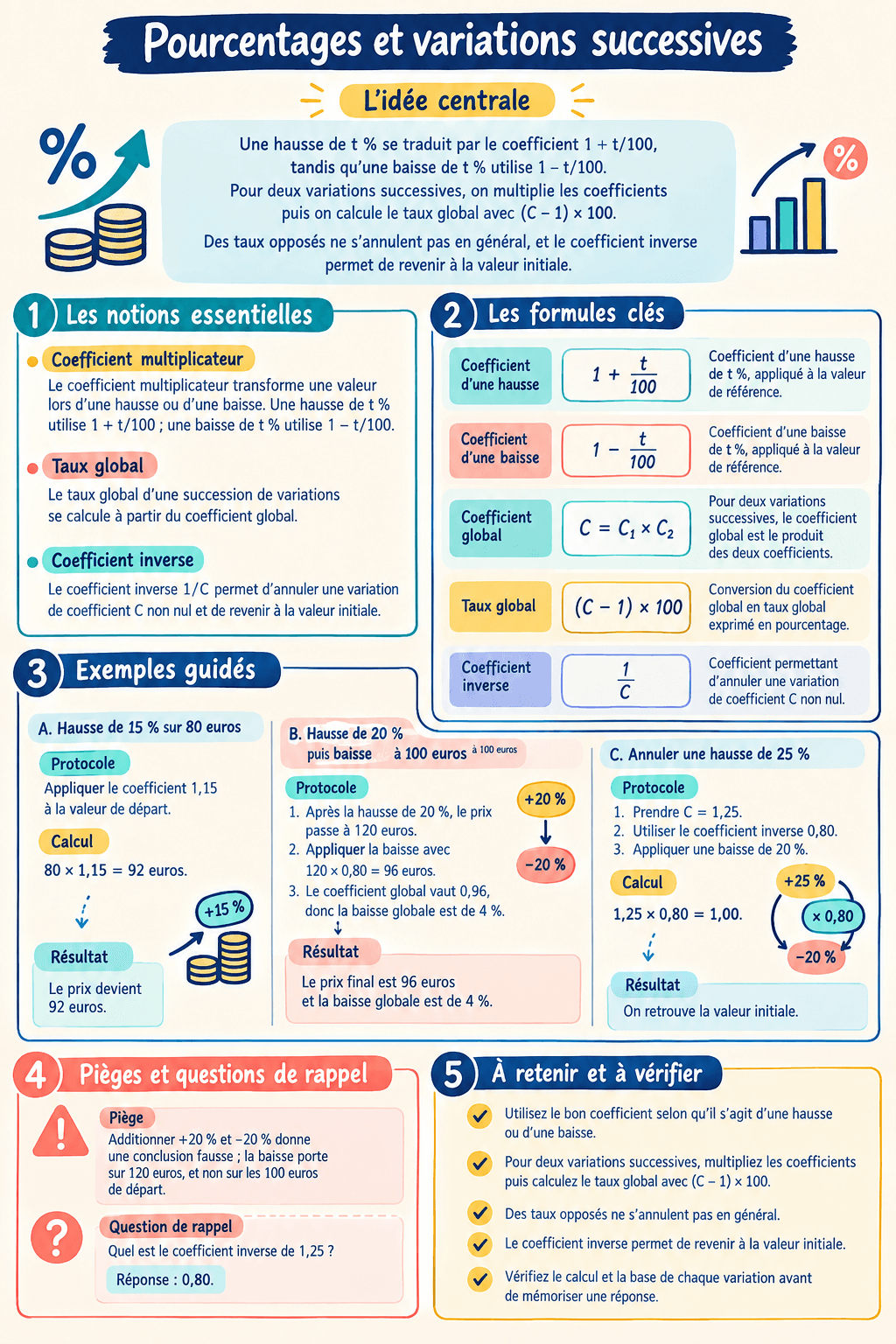
Visual sheets, corrected quizzes, chat about your course and flashcards: everything in one place. Start for free with your first sheets, no credit card.
| Criterion | Fichea€7.90 / monthPlus plan: €94.80 per year, or €9.90 per month with no commitment. | General-purpose AIVaries Free or paid. It’s up to you to write the right instructions. | Private tutoring21 € / hourTutoring: average published in March 2026. The rate depends on the teacher and the subject. |
|---|---|---|---|
| Quizzes with real traps, drawn from your course | Yes: Believable traps, corrected | Partly: Too easy without precise instructions | Partly: If they prepare any |
| Answers that stay within your course | Yes: Course passage cited | Partly: May go outside your syllabus | Partly: If they have your course |
| Visual sheets, not just text | Yes: Images, diagrams and colors | Partly: Mostly text | No: Do it yourself |
| Flashcards and spaced repetition | Yes: Generated from your course | Partly: No study schedule | No: On your own between sessions |
| Daring to ask a “dumb” question | Yes: No dumb questions | Yes: No one watching | Partly: In front of the teacher |
| Available the night before the test, at 11 pm | Yes: At your own pace | Yes: At your own pace | No: By appointment |
Indicative tutoring rate: March 2026 average, according to the private tutoring barometer, accessed October 2, 2026. The tools and the support offered differ. Details of Fichea plans and quotas on the Pricing page.
Create your account, no credit card.
Subscriptions go through Stripe. Fichea never sees your card.
Terms of sale, privacy and AI policy open to everyone.
AI can be wrong. The source shown helps you check.
Examples, corrected questions and steps to prepare your next study session.
Study methods
An example of a one-week schedule for reviewing your courses with flashcards and quizzes, adapting the sessions to the hard notions.
Study methods
Organize your studying from course to exercise: a sheet to structure, a quiz to test yourself, a chat to understand and flashcards to review.
Study methods
Testing, spacing, interleaving and explaining: the principles for studying effectively, a typical week and the mistakes to avoid, from rereading to the night before.
Study methods
CNED, absent teacher, independent candidate: how to study alone, set yourself a goal, break up your course, correct yourself and know when to ask for help.
Study methods
Feynman technique: explain a notion as if to a younger student, spot your gaps, go back to the course, simplify. Steps, an example on inflation, limits.
Memorizing
You understand in class but forget everything? Why memory slips, the difference between understanding and remembering, and how to make your courses stick.
Memorizing
Definitions, dates, formulas or articles of law: break them up, recite, make flashcards in both directions and space out your reviews to remember word for word.
Memorizing
The J method: go back over each chapter at D+1, D+3, D+7, D+15 and D+30. How to keep this calendar by hand, adapt it to your exam and automate it.
Memorizing
Active recall means retrieving your course from memory. What the studies say, 6 ways to practice it and a worked example.
Memorizing
Read, close your course, write down everything that comes back, then fill in with color: the blurting method step by step, with a full example in history.
Flashcards
From PDF to revision cards: choose the notions, check the answers and use your flashcards. Method and example of a corrected card.
Flashcards
One notion per card, a checkable answer and examples: learn how to write flashcards for definitions, dates and formulas.
Flashcards
Leitner method: build your 5-compartment box, set how often each one is reviewed and move your cards forward. Spanish example, limits, digital version.
Quiz and multiple-choice quiz
Prepare a quiz from your course PDF: choosing the chapter, questions, explained correction and going back over mistakes. Example of a multiple-choice quiz on percentages.
Understanding your course
Ask for an explanation, an example or the steps of a line of reasoning based on your PDF. Sample questions and a method to check the answers.
Understanding your course
A mind map links the notions of a chapter around a central theme. How to build it from your course, an example in economics and social sciences, and its limits.
Understanding your course
Notes, cue questions and summary: the Cornell method splits your page into three zones. How to use it in class, then for studying, with an example.
Organize your studying
Exam tomorrow and nothing studied? How to sort the chapters, test yourself, sleep instead of pulling an all-nighter, and prepare for next time without panic.
Organize your studying
Start small, the two-minute rule, phone out of reach, short sessions and rewards: concrete ways to stop putting off your studying.
Organize your studying
Too many chapters and not enough time? Take stock, sort by weight and deadline, break it into blocks and start with a test to know what to review.
Organize your studying
Employee, work-study student or going back to school? Study in short sessions on your commute and in the evening, with a typical week of 4 to 5 hours and regular tests.
Organize your studying
The Pomodoro method applied to studying: 25/5 as a starting point, what to put in each block, the 50/10 variant, a typical session and pitfalls to avoid.
Exams and competitive exams
Blocus in Belgium: definition, the 2026-2027 UCLouvain calendar as an example, a schedule by course and by ECTS credits, a sample day and tests on your syllabus.
Exams and competitive exams
University midterms: list your UE and their coefficients, sort your handouts and follow a two-week or seven-day plan, with past exams, quizzes and oral practice.
Exams and competitive exams
Bachelor’s resits, the bac oral or the second session in Belgium: check the rules, analyze your failure without guilt, target your UE and plan your summer.
Studying with AI
AI can quiz you, re-explain a passage or create questions on your course notes. What is allowed, the risks and 5 prompts to copy for studying.
Yes, depending on your plan. Take a clear photo or pick an image from your gallery, then check the recognized text. Legible handwriting matters.
Yes. Create a free account, no credit card needed. The Pricing page lists the features and limits of each plan.
A free AI can summarize your course. Fichea is built for studying: visual sheets, quizzes with real traps and their corrections, and a chat that stays within your course, with the passage cited as backup. The Pricing page lists what each plan includes.
Quizzes drawn from your course test your understanding and explain the answers. Flashcards help you memorize: a question on the front, the answer on the back.
Yes. Log in to the same account on your phone or computer to find your sheets and study.
Yes, the AI can be wrong. Check important information against your course, especially formulas, dates and definitions.
Free sign-up, no credit card.